

Understand the code and reuse the insight.
Setsumei analyzes how a codebase connects, identifies potential issues and prioritizes them using structural context. Open the generated HTML scan brief in a browser, or let compatible coding agents query stored analysis through MCP. Run on demand and refresh after changes.
Start with how the code connects.
A new codebase or a proposed refactor raises the same question about what else is connected to this part of the system.
Explore components and relationships in the local GUI brief. Inspect callers, dependencies, entry points and paths to focus code reading, review and test planning.
Use structural analysis, inferred communities and architecture documentation to investigate boundaries and orient new engineers. The map shown here uses folder-derived groups; it is not an illustration of inferred communities.
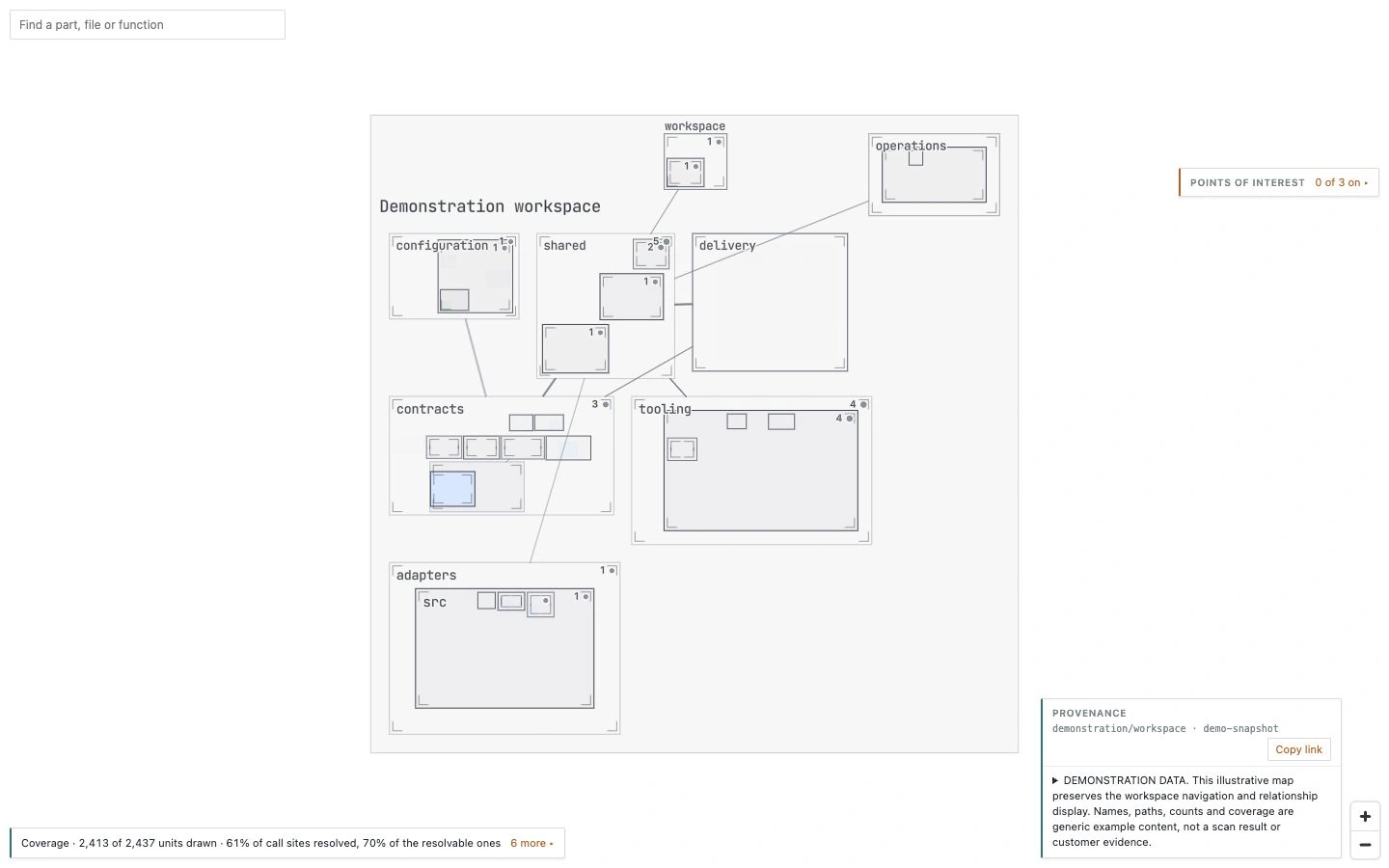
Follow a finding into the evidence.
Review security, performance, reliability and structural candidates alongside cycles, bottlenecks and dead-code analysis. Structural importance helps focus attention on code that may have wider consequences.
A finding gives you something specific to inspect: the candidate, supporting source and relationships. Where optional model-assisted investigation ran, review its outcome and reason, then decide what still needs to be checked.
The example shows a candidate and an investigation outcome. A machine-assessed result is input to engineering judgment; it does not establish release safety.
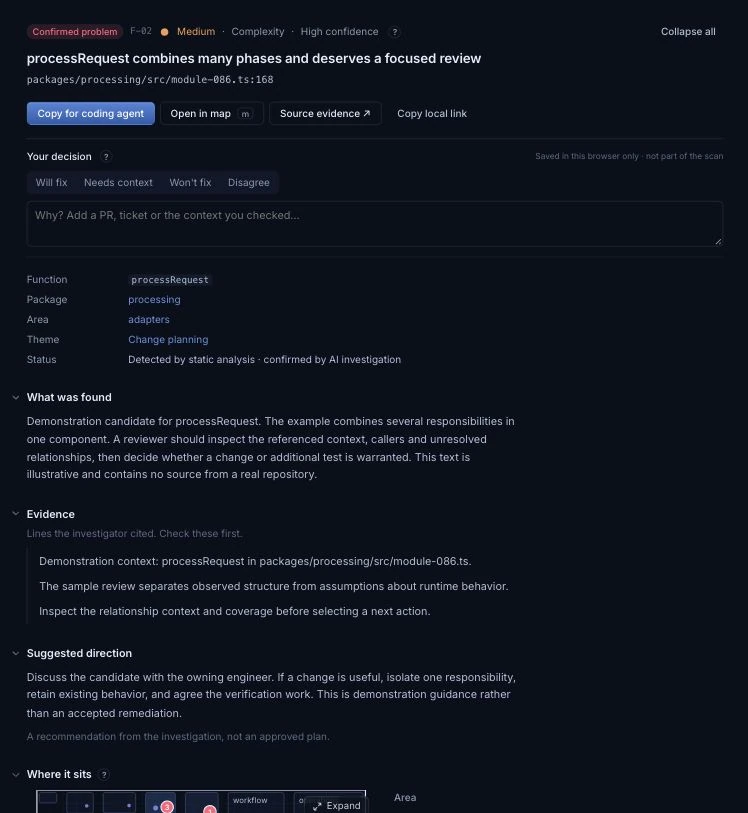
Query the analysis before planning an edit.
A compatible agent can query relationships, findings, source and freshness through local read-only MCP. Reuse stored context across tasks instead of rediscovering every relationship through file reads.
Opening the generated HTML presents the scan brief. Connecting an MCP client is separate. Refresh analysis after relevant changes, and check freshness and result limits before relying on an answer.
Explore MCP workflows →Structure first, then investigation where it helps.
The core deterministic static analysis constructs the relationship model, candidate findings and structural priorities without an LLM or model API key. An optional AI-assisted investigation step calls a language model to examine selected candidates with supporting context. Inspect the source, resolution coverage and unknowns when interpreting the results.
Setsumei currently analyzes JavaScript, TypeScript, C#, Java, Go and Python. Depth varies by language and framework, so fit is confirmed per repository. Refresh analysis after relevant code changes; results describe analyzed code, not a continuously updated view. Confirm version/build fit and local prerequisites for your repository.
Evaluate one question, then explore repeat use.
Start with an engineering task and discuss what useful results would look like. Evaluate whether Setsumei can become a repeatable part of your team’s work.