
Give your coding agent the context around its next change.
A compatible agent can query Setsumei for callers, dependencies, subsystem context, findings and source instead of reconstructing every relationship from file reads. The local read-only Model Context Protocol (MCP) interface exposes stored analysis with freshness information and result limits.
> Before I change
  payment_router,
  what depends on it?
 EVIDENCE
found callers + dependencies
mapped subsystem context
visible unresolved calls
linked findings + run
freshness + query limits
Orient to the repository
Start with system structure, entry points, subsystems and analysis coverage before asking the agent to plan a change.
Find what depends on this
Inspect who calls a component, what it calls and bounded dependency paths around it. Use structural importance and unresolved references to focus further review.
Retrieve source and implementation context
Look up findings and source for a component, find components by structural attributes, and inspect a module’s public surface before writing new code.
Check freshness and refresh
Check the analysis run, findings provenance, query limits and freshness. After relevant edits, refresh the analysis before relying on old answers. Use the freshness and query checks when interpreting a result or an analysis-in-progress warning.
A read-only view of the analysis, under your control.
Read-only applies to Setsumei’s query tools. Your agent can have independent editing tools and model data paths. Current MCP runs locally, per developer and repository, against the customer-managed analysis store. Your organization controls what the client retrieves and where it processes that context. Review PostgreSQL storage and the current local MCP scope.
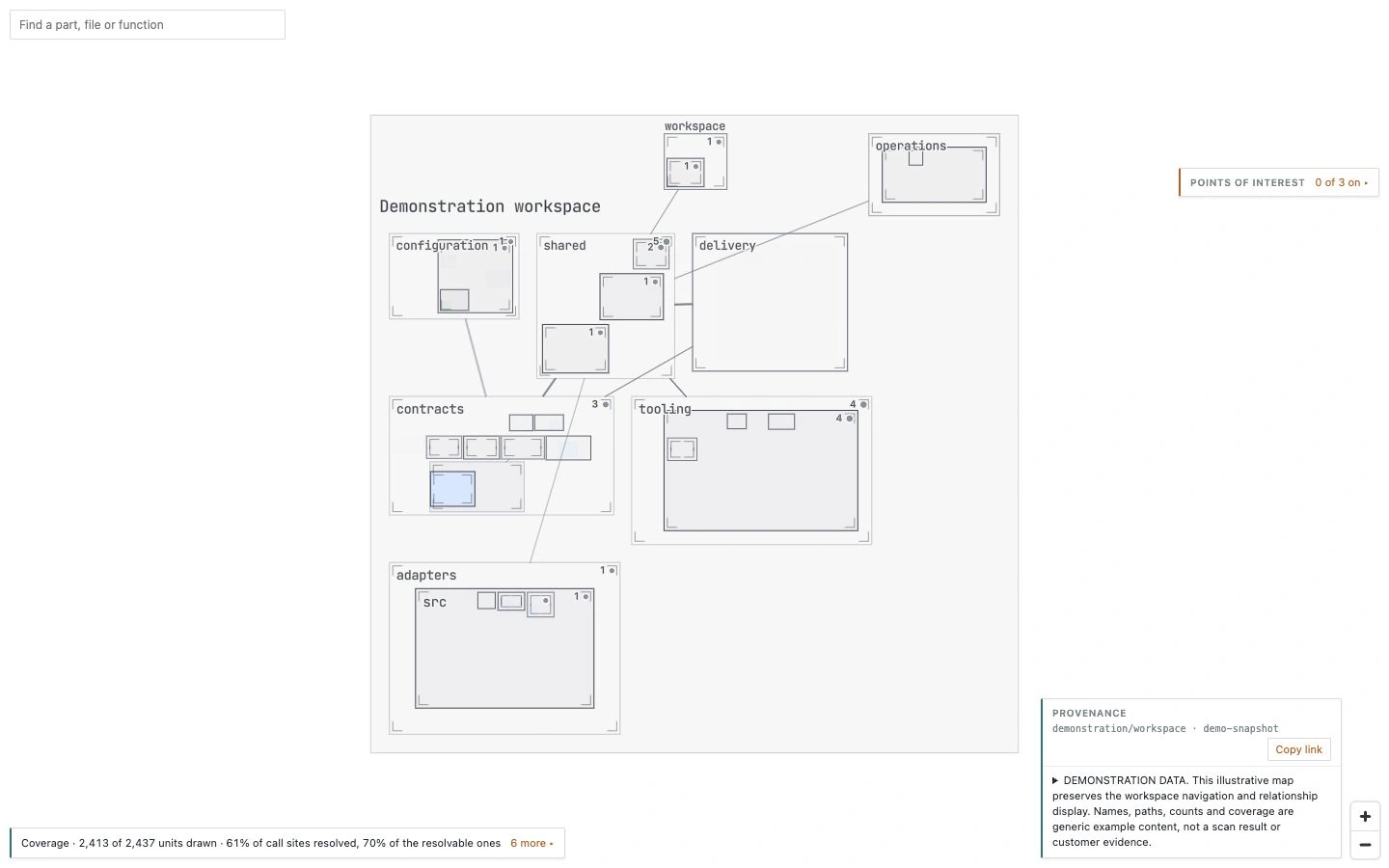
The displayed areas are folder-derived groups, distinct from graph-inferred subsystem analysis.
Bring one agent workflow and one change your team already needs to review.
Your engineers can test orientation, dependency queries and source retrieval against a task in your environment. Describe the intended workflow in your inquiry; the evaluation does not require sharing your codebase or analysis with Syntaxa.