syntaxa · architecture intelligencearchitecture intelligence

The Control
Layer for
AI-Era Software
Systems

Syntaxa builds infrastructure for teams operating
software systems too complex to fully
understand manually — and AI systems too important to
trust blindly.

Setsumei reconstructs how systems actually work.

RunQC verifies how AI behaves inside them.

Together, they create a new layer of engineering
intelligence for the AI era.

01 · the shift

Software changed faster than
the tooling
around it

Engineering organizations are entering a new operating environment.

The Environment

  • AI writes production code.
  • Agents execute workflows autonomously.
  • Systems evolve faster than humans can reason about them.
  • Architecture changes continuously across repositories, services, dependencies, and teams.

The Result

  • Architecture drift no one notices
  • Hidden dependency risk
  • Dangerous refactors
  • Modernization failures
  • Operational fragility
  • AI agents operating without architectural context
  • Engineering teams making decisions from incomplete understanding

The next generation of infrastructure must help teams understand systems structurally and verify AI behavior operationally.

That is why Syntaxa exists.

02 · the platform

Two products,
One architecture
intelligence platform.

Structural Truth

How the system is actually built.

Architecture intelligence reconstructed directly from source, not whiteboards, not assumptions.

Behavioral Confidence

How software and AI behave inside it.

Continuous verification across functionality, security, reliability, and hallucination risk.

setsumeisetsumei

Architectural ground truth from code

Setsumei reconstructs how software systems actually work directly from source code.

It creates structural understanding across:

01_Services02_Modules
03_Dependencies04_Trust Boundaries
05_Operational Hotspots06_Architectural Drift
07_Modernization Risk08_Blast Radius

The result is a continuously regenerable architectural model teams can use for modernization, due diligence, incident analysis, and AI-assisted engineering workflows.
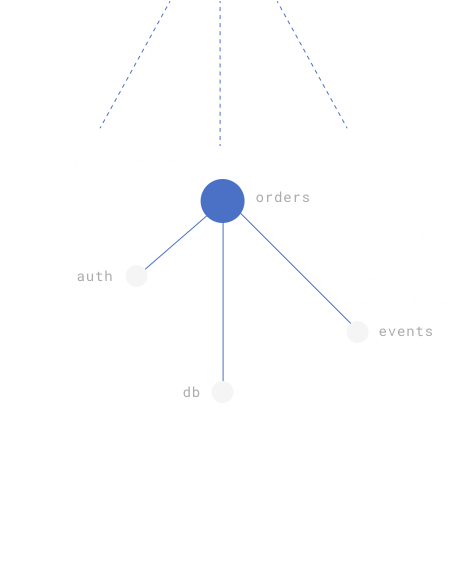
import { db } from "./db" import { auth } from "./auth" import { queue } from "./events" export class orders { async place(input) { const u = await auth.verify() const o = await db.create(...) await queue.emit("order", o) return o } }
dependency graph
runQC

RunQC · agent v4.2.1 · 293 cases

functionality, security, reliability, hallucination, regression, workflow

Operational verification
for AI agents.

RunQC helps teams evaluate whether AI systems behave safely, reliably, and within operational expectations before autonomous actions impact production systems.

It provides repeatable evaluation across:

01_Agent Behavior02_Tool Usage
03_Policy Compliance04_Hallucination Risk
05_Workflow Integrity06_Execution Safety
07_Operational Trust Boundaries

As agents become operational infrastructure, verification becomes mandatory.

03 · why both matter

AI created two new
infrastructure problems

As AI becomes deeply integrated into software development and operations, engineering organizations now face two foundational problems.

Problem One

What is the system, actually?

Humans no longer fully understand the systems they operate.


---> THAT IS SETSUMEI

Problem Two

Can the AI inside it be trusted?

AI agents increasingly operate inside
those systems without sufficient
verification or operational
safeguards.

---> THAT IS RUNQC

Without architecture intelligence, AI systems lack reliable context.
Without operational verification, autonomous systems become organizational risk.

---> Together, Syntaxa creates the missing control layer between increasingly complex
systems and increasingly autonomous software.

UNDERSTAND
FIX
TEST
SHIP
04 · why now

The speed of
software creation
has exceeded
the speed of
software
comprehension

Software complexity was already increasing before AI.

Modern systems contain:

01_Distributed Services02_Multi-Language Repositories
03_Evolving Infrastructure04_Deep Dependency Chains
05_Hidden Coupling06_Years of Accumulated Architectural Drift

Now AI accelerates software creation even further. Code generation is becoming effectively free.

Understanding the consequences of that code is not.

Current tooling focuses on:

01_Runtime Telemetry02_Syntax Validation
03_Isolated Vulnerabilities04_Documentation
05_Observability

Modern engineering organizations increasingly need:

01_Structural Understanding02_Architecture Reconstruction
03_Blast Radius Visibility04_Modernization Intelligence
05_Dependency Reasoning06_AI Operational Verification

--> Syntaxa exists to solve those problems.

05 · who this is for

Built for organizations operating
at architectural scale

Built for organizations operating at architectural scale.

Primary Buyers
01_CTOs02_VP Engineering
03_Platform Engineering Teams04_Principal Engineers
05_Staff Engineers06_Architecture Leadership
07_AI Engineering Leadership
Secondary Buyers
01_Technical Diligence Teams02_Enterprise Modernization Programs
03_OSS Ecosystem Maintainers04_Investors Evaluating Technical Quality
06 · what makes syntaxa different

Not another AI coding tool

Syntaxa is not:

A documentation generator
A code assistant
A linter
A static analysis wrapper
An observability platform
A code search engine

Syntaxa focuses on understanding systems structurally and verifying autonomous behavior operationally.

The platform is built around:

Deterministic architectural reconstruction
Dependency graph intelligence
Verified findings
Architecture reasoning
Operational AI evaluation
Continuously regenerable system understanding

This creates infrastructure designed for the realities of AI-era software systems.

The future of software engineering
requires infrastructure that
understands systems structurally,
not just operationally.
Understand the system.
Verify the AI.
Reduce the risk.
contact

Let's talk about your systems.

Planning a refactor? Preparing for due diligence? Deploying AI agents into production? Trying to reduce technical risk before it becomes financial risk?

[ SYNTAXA INSTALLER V1.0 ]